
King William Projected Release Meaning
Projected, estimated, tentative, good-time, mandatory-parole, parole-eligibility, and actual release dates mark different events. A projected date is a calculation. An actual release is the completed custody event. A parole-eligibility date only marks when consideration may occur, not approval or departure. A supervision end date applies after community release and should not be mistaken for a prison exit date.
A pretrial MPRSC detainee generally has no calculated release date. Departure may depend on bond, dismissal, a court order, case disposition, or another authority. A docket can show a hearing or bond, but it cannot predict when bond will be posted or whether another hold will delay the exit.
Find King William Projected Release
Begin with the custody authority. Middle Peninsula Regional Security Center handles many adults held on King William local matters. VADOC becomes the correct route after a state-responsible transfer. Federal paths apply only when known facts place the person in federal custody.
- Check the MPRSC current list for present local custody.
- For a local sentence, call 804-758-2338 and ask for records or time-computation routing.
- Review the correct King William court disposition and active sentence.
- For state custody, search the VADOC locator by exact seven-digit DOC ID or name.
- Read the date label exactly and note the displayed status or location.
- Ask VADOC records when a public field is missing or unclear.
- Confirm the actual event through the later release status, letter, or signed order.
The VADOC form accepts first and last name or the exact DOC ID. A name search requires at least the first three letters of the first name and the full last name, with optional narrowing fields. It also requires the disclaimer and CAPTCHA. Do not rename a displayed field without verifying its label.
VADOC King William Date Fields
The locator is the public first check for a state-responsible King William County person. It covers institutions and community supervision. A correctional facility means custody continues. A community district describes supervision after release. No result alone proves neither release nor discharge.
The official VADOC locator shows the state search route:
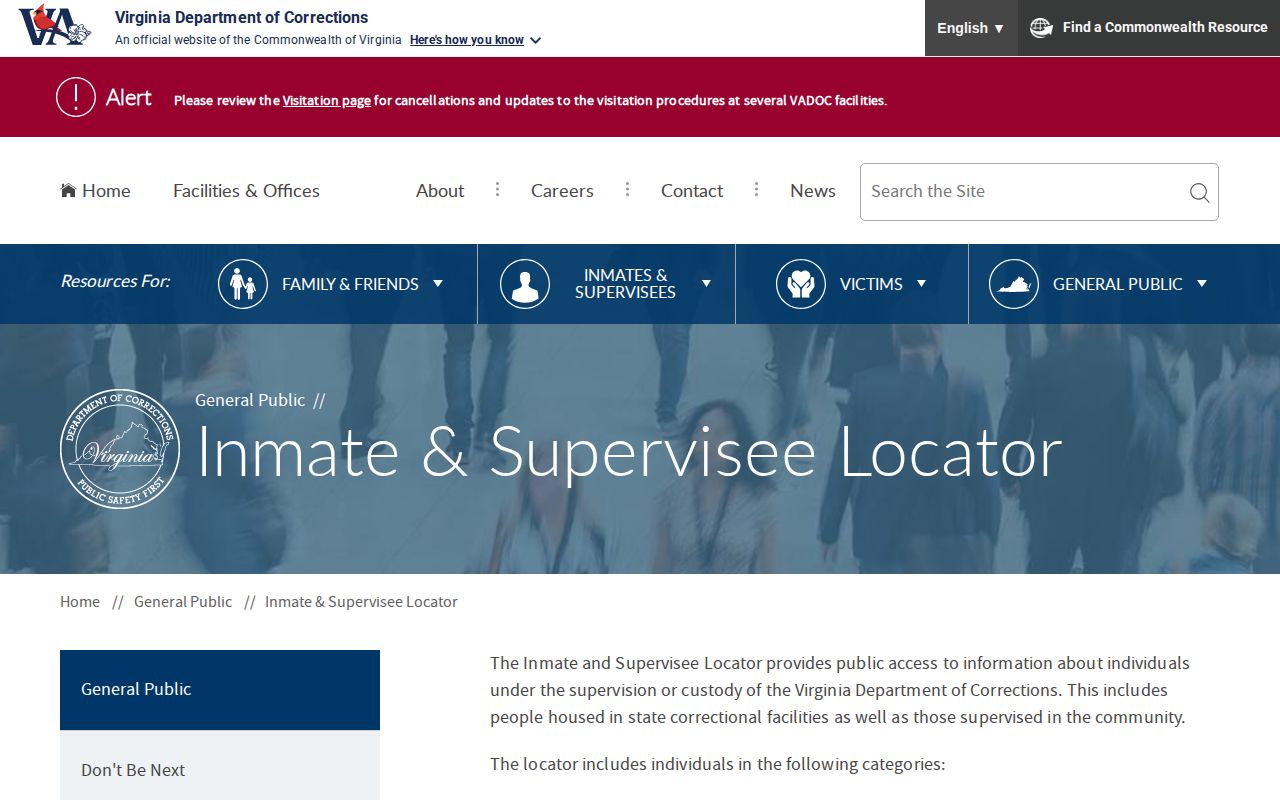
The result must be matched to the right identity before its location or release-related date is used.
| Returned item | Meaning |
|---|---|
| Institution | The person remains in a VADOC facility. |
| Community district | The person may be under probation or parole supervision. |
| Release-related date | Use the portal's exact label and treat a future value as provisional. |
| No result | Check spelling, local custody, federal custody, and records limits. |
King William Sentence Credit Systems
Virginia uses more than one credit framework. Good Conduct Allowance generally concerns felony offenses before January 1, 1995 and misdemeanor offenses before July 1, 2008. For qualifying active parole-eligible GCA sentences over 12 months, VADOC computes relevant parole and good-time dates. GCA can range from zero to 30 days per 30 days served, depending on class.
Earned Sentence Credits generally apply to felonies committed on or after January 1, 1995. Under the researched version of section 53.1-202.3, listed offenses in subsection A have a maximum of 4.5 credits per 30 days. Other eligible offenses can use levels of 15, 7.5, 3.5, or zero days per 30. Classification is reviewed at least yearly and may change. One credit removes one day under section 53.1-202.2.
The VADOC time-computation page explains the state frameworks:
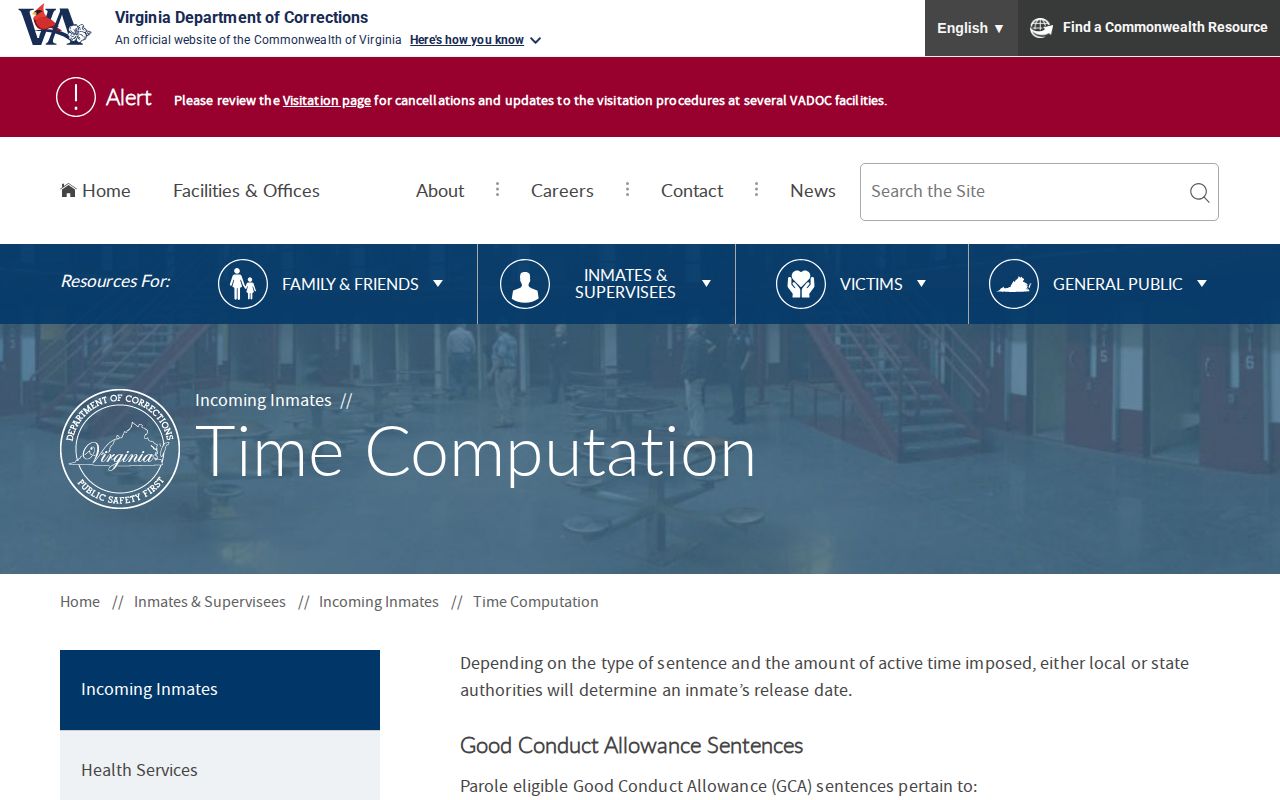
Offense date, sentence type, statutory version, and earning class must be checked before applying a rate.
King William Local Jail Credits
Local jail credits do not always follow the state-prison calculation. Virginia Code section 53.1-116 requires jailer records and a written earned-credit policy. Subject to mandatory minimums and other limits, a person sentenced to no more than 12 months for a misdemeanor or combination may earn one day of good-conduct credit for each day served, including qualifying presentence days, while following jail rules.
Parole-eligible prisoners can earn at the specified 15-per-30 rate. A jailer may grant another five per 30 for available work, classes, or workforce programs. Post-1995 felony jail credits cannot exceed the applicable Article 4 limits. For a short local King William sentence, ask MPRSC's records or time-computation function rather than applying a state result from another case.
Note: The phrase serve 85 percent is historical agency shorthand, not a calculator for every current Virginia sentence.
Changes to King William Release Dates
Several verified factors can move a projection. Some alter the sentence calculation. Others prevent community release even if one authority's date arrives.
| Factor | Possible effect |
|---|---|
| Prior jail credit | Changes time already credited toward the active term. |
| Earning class | Changes the rate at which eligible credits accrue. |
| Disciplinary offense | May lead to credit forfeiture under section 53.1-189. |
| New or corrected order | Can alter active time or sentence structure. |
| Concurrent or consecutive terms | Changes how multiple sentences combine. |
| Detainer or hold | May shift the person to another authority. |
| Parole action | Can affect an eligible old-law release path. |
A mandatory minimum, offense category, statutory exception, or time credited from another confinement may also control. The King William VINELink inmate search can provide a custody-change alert, but it does not certify the arithmetic.
Weekend King William Release Calculations
MPRSC publishes a local nonconsecutive sentence option under Virginia Code section 53.1-131.1. When authorized by the court and the remaining active part is 45 days or less, a person may report at 6 p.m. Friday and serve successive weekends. The Friday time is a reporting time, not a general release hour.
Physical confinement can alternate with weekdays in the community while the sentence remains active. A positive test, lateness, serious rule breach, or failure to report may end the privilege and convert the remainder to continuous confinement. This is why absence from the MPRSC current list is especially unsafe as proof of final discharge.
The official weekend information documents that distinct King William County release-date issue:

The court order and MPRSC computation, not a simple calendar count, control that arrangement.
Confirm King William Actual Release
VADOC says a person leaving a state facility on discharge or parole reads and signs the applicable Order of Release, Conditions of Probation, or Conditions of Parole with a staff witness. The person also receives a notification-of-release letter. Those documents are stronger proof than a future locator date.
State-facility discharge or parole occurs by 11:59 p.m. on the release date, weather permitting. That is a VADOC rule. MPRSC has not published the same general release-time promise. For a local exit, request the actual MPRSC release date, time, disposition, and receiving agency if transferred. A state transfer is not community release.
Parole requires careful sequencing. Eligibility means consideration may occur. A Board grant means parole was approved through the Board process. Neither is the physical exit timestamp. The VADOC release status, notification letter, and signed conditions show the later release step. Final discharge occurs still later, when supervision ends.
For local custody, compare the jail record with the court case. General District Court handles misdemeanors and preliminary felony stages. Circuit Court supplies felony adjudication and sentence. A court order can authorize release, yet another case, hold, transport step, or administrative process may affect the moment the person leaves MPRSC. The docket is not an exit scan.
Use a custody timeline when sources appear to conflict: admission, court order, credit computation, projected date, transfer or hold, actual release, and later supervision. Do not force each item into one release-date field. Recording the agency and exact label beside every date makes the result easier to verify and keeps a projection from being repeated later as a completed event.
King William Credit Inputs
A reliable inquiry supplies the sentence and custody facts that the calculator uses. These include the offense date, total active term, prior jail credit, sentence type, mandatory minimum, concurrent or consecutive structure, and the applicable earning class. A new order or correction can alter the inputs. Credits may also be forfeited for rule violations under section 53.1-189, and restoration rests within the statutory authority described there.
Operating Procedure 050.6 treats projected parole eligibility, mandatory parole, and good-time release dates as information that authorized VADOC staff may release at the time of inquiry, subject to law and procedure. That makes a records inquiry useful when the public locator omits or ambiguously labels a date. Ask staff to identify the date type rather than requesting a general prediction.
Virginia's general abolition of parole for post-1994 felonies has exceptions, including specified cohorts. Credits also do not reduce the time needed to become parole eligible. The offense date and full statutory rule must be matched to the case. A rate copied from a different person can produce a plausible but false date.
A detainer changes the practical outcome without always changing the first authority's calculation. MPRSC or VADOC may finish its term and transfer the person to another jail or federal agency. Record both the calculated end and the receiving custody. When the destination is unknown, ask for the release disposition and receiving-agency field rather than assuming that the projected date meant release to the community.
Weather can also affect VADOC's stated release process. Its facility guidance uses an 11:59 p.m. deadline on the release date, weather permitting. That state rule is not an MPRSC promise and should never be used to estimate a regional-jail exit hour.
The state facility-release process supplies more than a clock time. VADOC says records staff address pending actions and release documents, the business office can arrange bus transport when needed, and property staff return personal belongings. The released person reads and signs the applicable order or conditions with a staff witness and receives a notification-of-release letter. These completed steps distinguish an actual discharge or parole from a date that remained only a calculation in the locator.
Keep copies of both the earlier projection and the completed release document. A change between them can reflect lawful recalculation, lost or restored credits, a corrected order, or another custody event. Quote the final record with its issuing agency and date.