
Where BOP Releases Go
Federal Bureau of Prisons facilities nationwide hold sentenced federal people and manage some community-based placements. No federal prison was identified in King William County. A federal defendant connected to the county may be confined far from Virginia. The BOP locator is therefore a national system page, not a local facility roster.
A past release date paired with no facility location, or a status of released, means the person is no longer in BOP custody. That statement has limits. It does not show that a term of supervised release has ended, and it does not rule out immediate transfer to another authority. A person listed under Community Corrections Management or a contract halfway-house arrangement remains in a BOP placement. An in-transit label means movement, not return to the community.
| BOP result | Careful reading |
|---|---|
| Released with past date | No longer in BOP custody as of the recorded event |
| Future release date | Projected date that may change |
| Unknown | Sentence term or release date is undetermined |
| In Transit | Federal movement, not community release |
| CCM | Community Corrections Management placement remains tied to BOP |
| Not in BOP custody | Does not identify Marshals, local, state, or ICE custody |
Confirm a BOP Release
The official BOP Inmate Locator covers federal inmates from 1982 onward. Search by BOP register number, FBI number, DCDC number, or INS number. A name search can be narrowed with age, race, and sex. Compare the register number and identity fields before opening or recording a result.
- Confirm that the case was federal and that the person likely entered BOP custody after sentencing.
- Use the register number when known. It is more precise than a common name.
- Read the name, number, age, race, sex, release date, and location together.
- Apply BOP's own status definitions. Do not rename in-transit or CCM placement as release.
- Use the federal court or agency records when the public result does not answer the exact custody question.
The official locator shown in the captured source is the correct federal search:
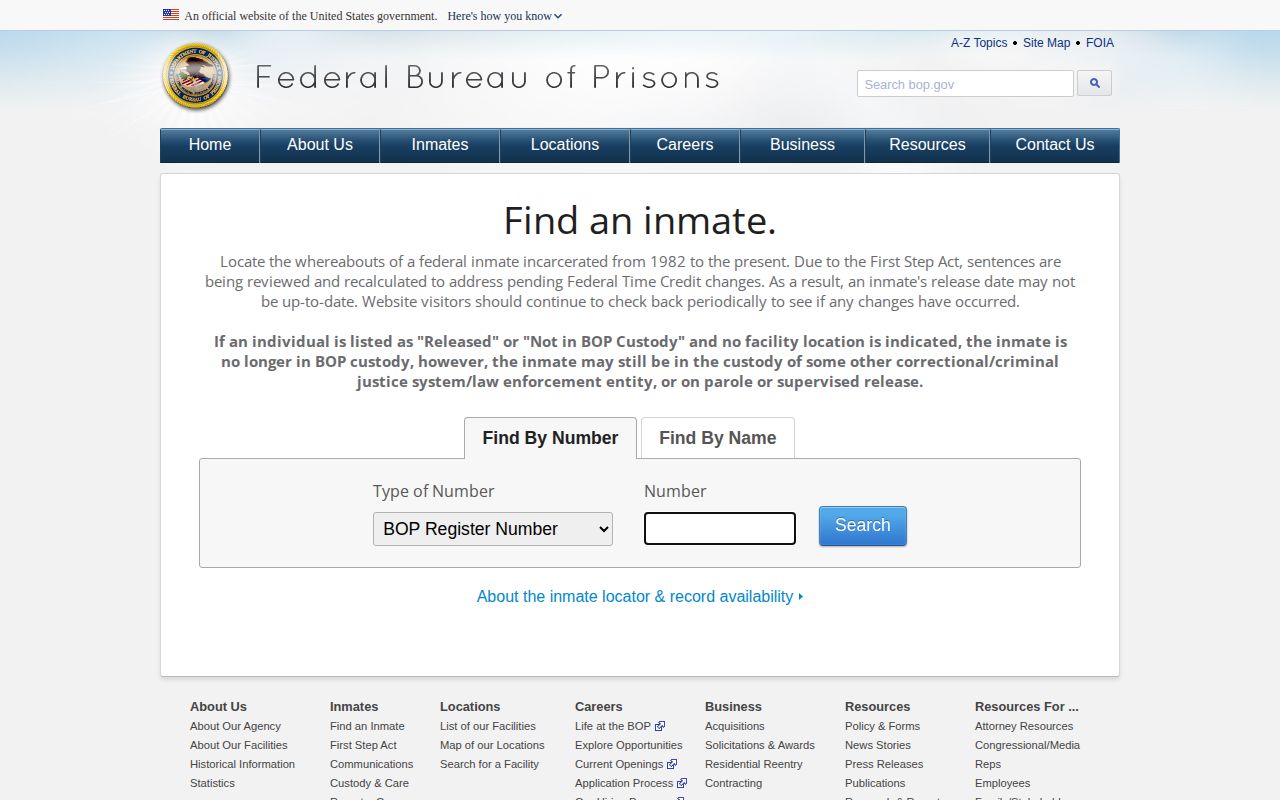
The form can establish a BOP status, but it cannot certify release from MPRSC or current Marshals custody.
BOP Records and Contact
This entry covers a nationwide agency, so no King William street address, local release desk, or single facility telephone should be shown. Use the locator for public status and the specific BOP institution only when a result identifies one. Older records can require the National Archives. A historical or certified release record may require the federal records process and proof of identity or authorization.
Federal Bureau of Prisons
Nationwide federal prison system
Public route: BOP Inmate Locator
Status definitions: BOP inmate-locator records page
Institution contact: use the facility identified in the official BOP result
The BOP explanation of locator records is part of the search, not optional fine print. It defines released, projected, unknown, in transit, and CCM results. Quote the label and date as displayed. If exact release papers or movement records are needed, request the existing agency record rather than asking a local jail to interpret federal data.
BOP Federal Custody Scope
BOP covers sentenced federal custody. The U.S. Marshals Service manages federal pretrial detention and transport and can house a person in a non-BOP facility. That division explains why a federal court case can exist with no BOP result. It also explains why release from Middle Peninsula Regional Security Center on a Marshals hold can be a federal transfer.
BOP does not establish release from an adult regional jail, VADOC, or ICE. The King William County released inmates search uses the case facts to select among those systems. Starting with the wrong sovereign can create a false release claim even when the name search itself was accurate.
BOP and MPRSC Transfers
Middle Peninsula Regional Security Center serves local adult matters for King William and four other member jurisdictions. A row disappearing from its current list only shows that the person is no longer displayed in present MPRSC custody. If the MPRSC release record names the U.S. Marshals Service, a federal court, or another federal authority, the event should be described as a transfer unless later evidence shows community release.
A sentenced federal person may appear in BOP only after processing and transport. During that gap, the federal docket, counsel, or the responsible Marshals district may be more useful. The U.S. Marshals Eastern District of Virginia is the authoritative district route identified in the research, but it has no public historical release locator comparable to BOP.
Note: A local release timestamp and a later federal intake can both be correct because they describe different authorities in one custody sequence.
Build the BOP Release Record
A useful federal record set identifies the person, register number, facility, status, displayed release date, and the meaning assigned by BOP. Add the federal case number and judgment when the legal basis matters. If another agency accepted custody, include that agency's event as a separate record rather than overwriting the BOP release.
The federal court judgment can state sentence and supervision terms, but it may not record the exact time a prison completed release processing. Conversely, the locator can show a release date without explaining each condition imposed by the court. Read both records for their proper roles.
- Release date
- The date BOP publishes for the end or expected end of its custody, interpreted under BOP definitions.
- Supervised release
- A federal court-ordered period in the community after prison, distinct from BOP confinement.
- Detainer
- A request or authority that can lead to transfer instead of community return.
- Register number
- The federal identifier that helps separate people with similar names.
When BOP Finds No Record
A no-result search is not a release certificate. Check spelling and identifiers first. Then confirm the sovereign. The person may remain in local custody, be under VADOC, be held for federal court by the Marshals, be in ICE custody, have a record outside the locator's time range, or never have entered BOP at all.
For a federal pretrial matter, review the federal docket and speak with counsel or the proper Marshals channel. For immigration detention, use ICE only when facts support that path. For a King William local booking, return to the MPRSC release record. These checks prevent one database's silence from being stretched beyond its scope.
First Step Act recalculations and other sentence changes can alter future dates. Preserve the date checked and exact wording if a projected BOP value is being tracked. Later confirmation should use the updated official result and the final release documentation.
BOP Release Date Evidence
Release from federal prison and completion of supervised release are distinct. The federal judgment states the supervision term and court conditions. The BOP locator addresses prison custody. A past BOP release date should therefore be reported as the end of BOP custody, not the end of every federal obligation. The federal court or supervising authority supplies later status when lawfully available.
Older BOP history can require National Archives research. That route matters when a record predates the locator's 1982 coverage. Do not fill an older gap with an estimate based on sentence length. A judgment can identify the sentence, but credits, prior custody, later orders, and agency calculations may affect the actual release.
If BOP reports a future date, treat it as projected. First Step Act calculations and other updates may alter it. If the status reads unknown, preserve that term. If it reads in transit, look for the next institution or custody source. Exact wording prevents a search result from becoming a claim stronger than the agency made.
A careful King William inquiry starts with the known local or federal case number. If the matter began at MPRSC, request the receiving authority. If the federal docket shows pretrial detention, use the Marshals route. If the judgment shows a federal prison sentence, use BOP. That chain is more reliable than repeating a name across every system without evidence.
Public Record Search
Sponsored Results